
ResearchMarch 11, 2026
Bitcoin vs Gold: Where is the Alpha?
Executive SummaryThe macroeconomic landscape entering 2026 is defined by a single, overriding theme: uncertainty. Tariff escalations, persistent infla...
Cypher Capital | Sumeet Surana | March 2026
The pace of technological change has always been uneven.
In 2026, it’s becoming discontinuous.
Over the past few months, we’ve seen a pattern emerge: frontier AI labs are not just innovating faster, they’re compressing entire product cycles into weeks.
Anthropic’s recent release cadence suggests frontier AI labs are now shipping capabilities faster than many enterprises can operationally absorb. Across coding, legal tooling, cybersecurity, and legacy modernization, what previously took years to build is now being deployed in days.
This is not incremental progress.
It’s cycle compression at scale.
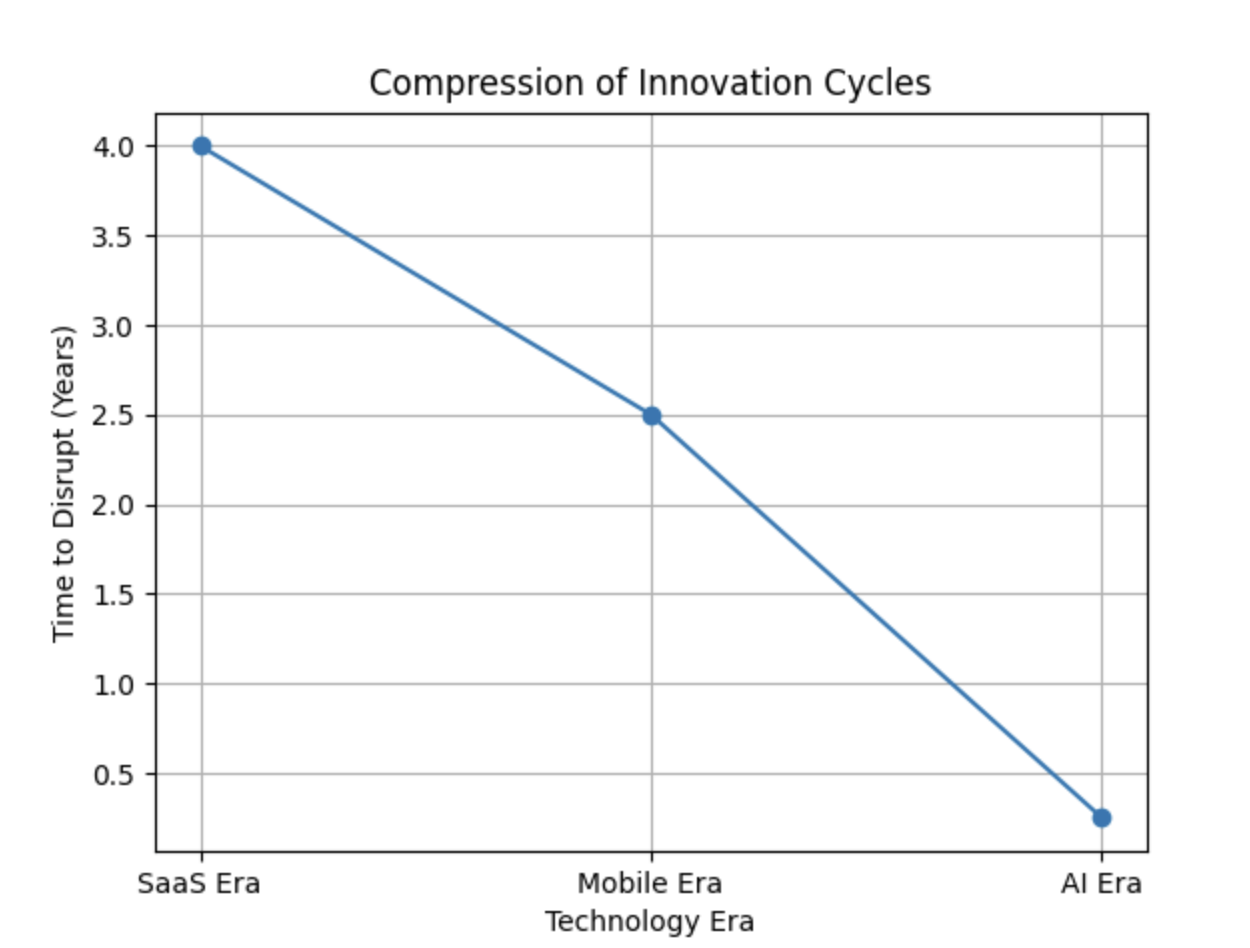
Innovation cycles are compressing - from years to weeks - reshaping how quickly markets reprice risk.
Recent market reactions illustrate how quickly value is being repriced:
AI-native features in legal workflows triggered double-digit drawdowns across incumbents (Thomson Reuters, RELX, LegalZoom)
Enterprise software and cybersecurity names have seen synchronized volatility following major AI releases
Legacy infrastructure exposure (e.g. mainframe modernization) is being reassessed in real time
Public markets are reacting faster than private markets can adjust.
At the startup level, the impact is even more acute.
Entire categories- ad automation, basic SaaS tooling, workflow software are seeing feature-level disruption, where a single model release can replicate core product functionality overnight.
This has introduced a new dynamic:
This shift is not just technological - it’s financial. Capital is already moving away from traditional SaaS models toward infrastructure, deployment layers, and AI-native services.
We’re increasingly hearing a common concern from early-stage founders:
“What if a model provider ships this next week?”
The cost of being early has risen.
The cost of being wrong has increased.
Innovation cycles have compressed to the point where:
MVP timelines are shorter
Competitive windows are narrower
Product defensibility is harder to sustain
This doesn’t mean innovation is slowing—it means the bar for durable value has shifted.
If software creation is becoming commoditized, the natural question is:
Where does value accrue next?
Historically:
SaaS captured value through scalability and distribution
Services lagged due to linear growth models
As of 2025 benchmarks:
Public SaaS: ~6–8x revenue multiples
IT services: ~1–2x revenue multiples
But this spread was built on one assumption: software is scarce, services are abundant.
That assumption is breaking.
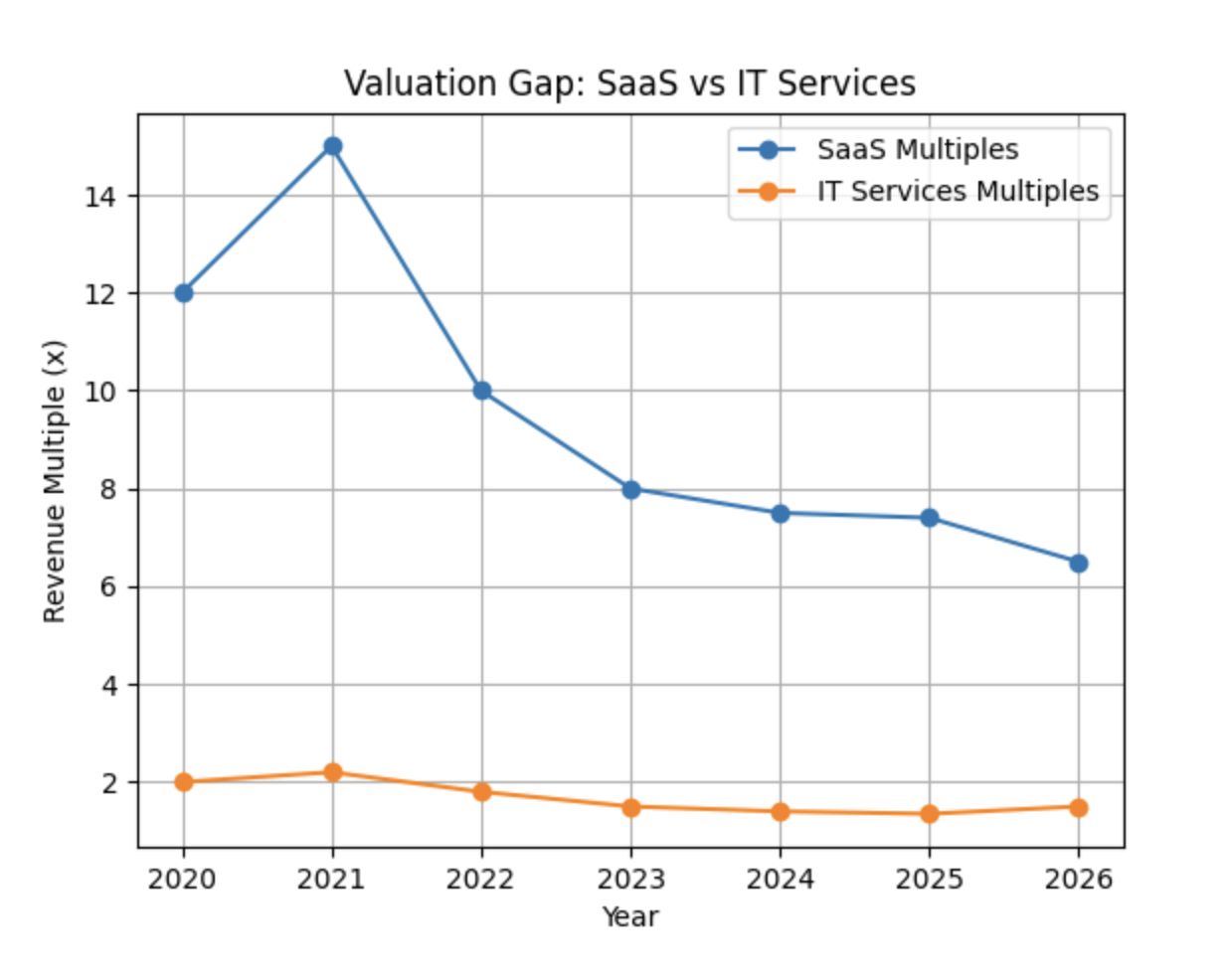
Public market multiples show a persistent gap between SaaS and services—one that may not hold in the AI era.
In a world where AI can generate software instantly, the constraint is no longer creation—it’s deployment.
Enterprises still operate within layers of real-world complexity: regulatory compliance across jurisdictions, integration with legacy systems (including mainframes and COBOL stacks), and increasing demands around data security, auditability, and governance. Beyond that, AI must be adapted to specific organizational workflows, with teams trained to use it effectively and systems maintained over time. These are not problems models can solve in isolation—they require infrastructure and services layers built around them.
As a result, we are seeing early signals of capital shifting toward three key areas.
At the foundation, a new infrastructure layer is emerging to support AI at scale. This includes model orchestration frameworks, data pipelines and retrieval systems, and privacy-preserving compute environments such as secure enclaves. Increasingly, decentralized compute is also entering the stack—marking the point where crypto begins to intersect directly with AI infrastructure.
Alongside this, a services layer is being rebuilt for the AI era. Implementation and integration are becoming critical capabilities, particularly as enterprises look to deploy AI within highly specific operational contexts. This is driving the rise of verticalized AI deployment firms across sectors such as legal, healthcare, and finance, alongside growing demand for security, compliance frameworks, and ongoing governance. In many ways, this layer becomes the bridge between AI capability and real-world adoption.
Crypto is emerging as the coordination layer for this new AI stack.
As demand for compute, data, and model access continues to scale, centralized systems are beginning to face constraints around cost, control, and trust. Decentralized networks offer an alternative—enabling distributed compute, verifiable data pipelines, and incentive-aligned ecosystems that can support AI at a global scale.
The narrative that “AI will kill startups” is directionally true—but incomplete.
What we’re actually seeing is a structural shift in where value accrues. Horizontal SaaS is beginning to compress as core functionalities are replicated faster and more cheaply by AI. At the same time, vertical expertise is compounding—deep, domain-specific solutions are becoming more valuable as generic software becomes easier to build. Beneath this, infrastructure is being re-rated as a critical layer in enabling AI at scale, while services are evolving from a support function into a strategic advantage.
Software may still eat the world.
But increasingly, infrastructure will power it—and services will capture the value of making it usable.
We are already seeing early signals of capital rotating into these categories.
Venture allocation is increasingly favoring infrastructure and verticalized deployment over horizontal SaaS.
Looking ahead, we believe capital in 2026 will concentrate in three areas:
Projects enabling:
Decentralized compute marketplaces
Verifiable data pipelines
On-chain coordination for AI agents
Not generic tools, but:
Industry-specific systems with embedded workflows
Deep integration into enterprise operations
High switching costs through customization
A rebranded, revalued category:
From “IT services” → to AI deployment platforms
Companies that combine human expertise + AI leverage
Potential outcome: multi-billion revenue businesses with hybrid margins
The last decade was defined by building software.
This decade will be defined by making AI usable, trustworthy, and integrated into real-world systems. The builders are still important.
But the orchestrators, those who deploy, integrate, and scale—will define the next wave of value creation.
The gold rush is here. But this time, the winners won’t just build the tools.
They’ll make them work.
Disclaimer:
*This report is published by Cypher Capital (BVI) Limited, a Business Company incorporated in the British Virgin Islands. Cypher Capital (BVI) Limited is not licensed or regulated by the Central Bank of the UAE, the Securities and Commodities Authority of the UAE, or the Virtual Assets Regulatory Authority of Dubai.
This report is provided for informational and educational purposes only and does not constitute investment advice, a recommendation to buy or sell any asset, or an offer or solicitation to invest in any fund, product, or strategy.
This report contains forward-looking statements and third-party price forecasts subject to significant uncertainty. Third-party forecasts cited reflect the views of those institutions, not of Cypher Capital. Cypher Capital, its affiliates, and employees may hold positions in the assets discussed herein.
No representation or warranty is made as to the accuracy or completeness of the information contained herein. Recipients should conduct their own independent analysis and consult qualified advisors before making investment decisions.
Copyright 2026 Cypher Capital (BVI) Limited. All rights reserved.*
Share this article
Executive SummaryThe macroeconomic landscape entering 2026 is defined by a single, overriding theme: uncertainty. Tariff escalations, persistent infla...

The numbers are extraordinary. Dell’Oro projects data centre capital expenditure will reach $1.7 trillion by 2030. Meta just broke ground on a $10 bil...